About me and why I created this physics website.
Rectilinear Motion
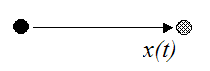
Rectilinear motion is another name for straight-line motion. This type of motion describes the movement of a particle or a body.A body is said to experience rectilinear motion if any two particles of the body travel the same distance along two parallel straight lines. The figures below illustrate rectilinear motion for a particle and body.
Rectilinear motion for a particle:
Rectilinear motion for a body:
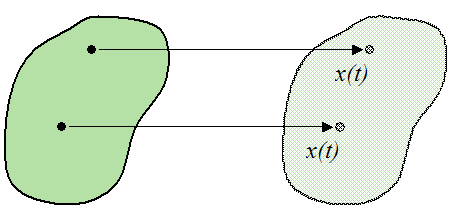
In the above figures, x(t) represents the position of the particles along the direction of motion, as a function of time t.
Given the position of the particles, x(t), we can calculate the displacement, velocity, and acceleration. These are important quantities to consider when evaluating the kinematics of a problem.
A common assumption, which applies to numerous problems involving rectilinear motion, is that acceleration is constant. With acceleration as constant we can derive equations for the position, displacement, and velocity of a particle, or body experiencing rectilinear motion.
The easiest way to derive these equations is by using Calculus.
The acceleration is given by
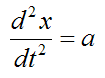
where a is the acceleration, which we define as constant.
Integrate the above equation with respect to time, to obtain velocity. This gives us

where v(t) is the velocity and C1 is a constant.
Integrate the above equation with respect to time, to obtain position. This gives us
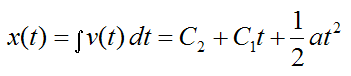
where x(t) is the position and C2 is a constant.
The constants C1 and C2 are determined by the initial conditions at time t = 0. The initial conditions are:
At time t = 0 the position is x1.
At time t = 0 the velocity is v1.
Substituting these two initial conditions into the above two equations we get
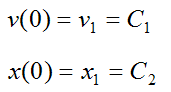
Therefore C1 = v1 and C2 = x1.
This gives us
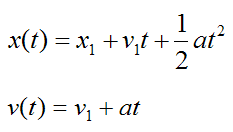
For convenience, set x(t) = x2 and v(t) = v2. As a result
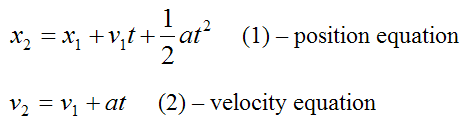
Displacement is defined as Δd = x2−x1. Therefore, equation (1) becomes

If we wish to find an equation that doesn’t involve time t we can combine equations (2) and (3) to eliminate time as a variable. This gives us

Equations (1), (2), (3), and (4) fully describe the motion of particles, or bodies experiencing rectilinear (straight-line) motion, where acceleration a is constant.
For the cases where acceleration is not constant, new expressions have to be derived for the position, displacement, and velocity of a particle. If the acceleration is known as a function of time, we can use Calculus to find the position, displacement, and velocity, in the same manner as before.
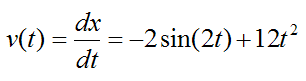
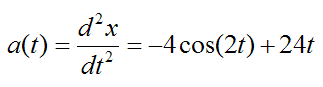
Alternatively, if we are given the position x(t) as a function of time, we determine the velocity by differentiating x(t) once, and we determine the acceleration by differentiating x(t) twice.
For example, let's say the position x(t) of a particle is given by
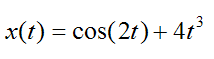
Thus, the velocity v(t) is given by
The acceleration a(t) is given by
Return to Kinematics page
Return to Real World Physics Problems home page
