About me and why I created this physics website.
Linear Momentum
The linear momentum for a system of particles can be derived from Newton’s Second Law. For a system of particles, this law states that:
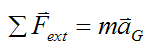
Where:
ΣFext is the vector sum of the external forces acting on the system of particles. This sum is sometimes called the net external force
m is the total mass of the system of particles
aG is the acceleration of the center of mass G of the system of particles, with respect to an inertial reference frame (ground). This acceleration is a vector in the direction of the net external force
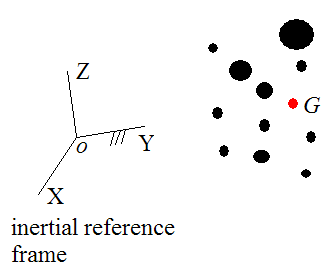
Note that there is no restriction in the way the particles are connected. As a result, the above equation will also hold true for a rigid body, a deforming body, a liquid, or a gas system.
Now, we can rewrite the above equation as
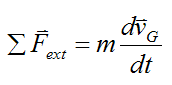
where vG is the velocity of the center of mass G of the system of particles, with respect to an inertial reference frame (ground).
The above equation can be expressed as
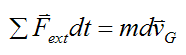
Integrating both sides from time ti to time tf we have
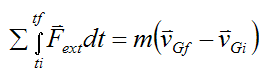
which becomes
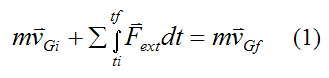
The term
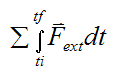
is defined as the external linear impulse acting on the system of particles (between ti and tf), due to the sum of the external forces acting on the particles.
We define the linear momentum for the system of particles as
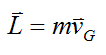
Therefore, equation (1) can be written as
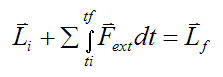
Note that there is no restriction in the way the system of particles are connected. As a result, the above equation will also hold true for a rigid body, a deforming body, a liquid, or a gas system. To see an example problem involving impulse and linear momentum see Rocket Physics.
If no external forces act on the system of particles, then

Linear momentum is therefore conserved for the system of particles (between ti and tf).
Return to Dynamics page
Return to Real World Physics Problems home page
